
Best 7 AI Projects Ideas for Finalyear CSE Students in 2025
October 24, 2025
Top 6 Data Mining Project Ideas for IEEE Students
October 30, 2025
In the world of modern computing, VLSI (Very Large Scale Integration) technology plays a crucial role in developing high-performance chips that power everything from smartphones to AI systems.
For today’s tech-driven era, choosing a VLSI project for CSE students in 2025 opens doors to innovation that bridges the gap between hardware and software.
With the global semiconductor industry rapidly expanding, mastering VLSI design empowers computer science students to stand out in competitive careers involving embedded systems, chip design, and automation.
Elysium Pro, a leading project development center, provides expert guidance, ready-made titles, and real-time mentorship to help students turn ideas into impactful projects.
This blog on Best VLSI Projects for CSE Students in 2025 will help you explore trending project topics, learn how to choose the right one, and understand the skills that make your academic journey future-ready and industry-relevant.
Table of Contents
Industry Evolution and Future Scope of VLSI Technology
- The current industry landscape for VLSI projects for CSE students in 2025 is evolving faster than ever. New innovations like AI driven design automation, energy efficient chip development, hardware level security integration, and advanced semiconductor manufacturing are setting the tone for what kind of expertise the market demands. These changes are pushing students to focus on practical and research oriented VLSI projects for CSE students that combine both hardware and software skills in real time applications.
- Across India, the semiconductor sector is witnessing a major hiring surge. Reports show that thousands of design and verification positions are opening up due to the government’s push for self reliance in chip manufacturing. Companies are actively seeking graduates with deep knowledge in VLSI design, embedded systems, and chip architecture. This trend indicates that technical graduates who build a solid project portfolio in this field will have a clear advantage during placements.
- CSE students today are no longer content with basic coding or theoretical work. They are searching for interdisciplinary learning opportunities where they can apply algorithmic thinking to real hardware implementation. This demand is creating a new wave of project based learning models focused on system level integration and design verification.
- At the same time, employers are increasingly prioritizing practical exposure. A candidate who can demonstrate real time problem solving in hardware description languages or chip design verification is far more valuable than someone with only software programming skills. This is why focusing on VLSI projects for CSE students that highlight both design and optimization techniques is a key differentiator.
- Another major shift is the growing emphasis on sustainable and secure chip solutions. Companies are exploring low power designs, secure architectures, and AI optimized layouts. Students who align their project work with these trends are likely to attract recruiters from top design and semiconductor firms.
- Ultimately, the message is clear. Your project choice must align with both industry needs and your own learning goals. When you choose meaningful VLSI projects for CSE students, you not only gain technical expertise but also position yourself as a well rounded engineer ready for the demands of the modern semiconductor industry.
Why VLSI Projects Are Critical for CSE Students
VLSI projects for CSE students have become an important part of modern engineering education.
While VLSI has traditionally been considered a domain of Electronics and Communication or Electrical Engineering, the demand for professionals who can bridge both hardware and software is growing rapidly.
Computer Science students have an advantage because they possess a deep understanding of algorithms, logic design, and programming, which are essential for developing and testing modern integrated circuits.
As the industry shifts toward advanced chip design, artificial intelligence, and embedded systems, students who can combine software logic with hardware implementation are in high demand.
Through VLSI projects for CSE students, learners gain hands-on exposure to digital system design, hardware description languages, and simulation tools that mirror real-world industrial applications.
In the competitive academic and professional landscape, project selection plays a key role in defining a student’s technical identity.
A well-chosen VLSI project not only demonstrates technical depth but also sets the student apart during final year evaluations, internships, and job interviews.
Engineering projects based on VLSI design encourage innovation, logical reasoning, and interdisciplinary thinking, helping students stand out in their portfolios.
Specialized project domains offer structured guidance that aligns academic requirements with real industry practices, ensuring that learners can build, test, and optimize their designs effectively.
By focusing on VLSI projects for CSE students, aspiring engineers gain the confidence to move beyond theory and apply their programming, hardware, and analytical skills in solving complex design challenges that define the future of technology.
Top VLSI Project Ideas for CSE Students in 2025
1. AI Accelerator Micro Architecture on FPGA

Brief Description
This project focuses on designing a compact neural network accelerator using FPGA technology, implemented through Verilog or SystemVerilog. The aim is to build a micro architecture capable of accelerating AI inference tasks such as image recognition or predictive computation. Students will design the datapath, control logic, and memory interfaces required to optimize performance for machine learning workloads. Through this project, learners explore how hardware can be customized to support deep learning algorithms, making it a strong addition to the growing list of innovative VLSI projects for CSE students. It gives students a solid understanding of how to translate high level AI models into efficient hardware implementations that run in real time.
Why it’s Demand
In 2025, the integration of artificial intelligence with hardware acceleration is transforming industries like healthcare, automotive, and edge computing. Traditional CPUs and GPUs are no longer sufficient to handle the massive computational demand of AI models. This has made FPGA based AI accelerators a major trend, offering both flexibility and high performance. VLSI projects for CSE students that combine AI and FPGA design help bridge the gap between algorithmic intelligence and hardware execution, which is now a key requirement in the semiconductor sector. Companies are actively hiring engineers who understand how to optimize machine learning workloads at the chip level, blending both software and hardware expertise.
Working on an AI accelerator project helps students gain critical experience in digital design, pipelining, and data flow optimization while also strengthening their understanding of AI processing architectures. It reflects the perfect intersection of machine learning, VLSI design, and embedded systems, making it one of the most valuable VLSI projects for CSE students in today’s technology driven world.
2. Low Power VLSI Design for IoT Edge Node
Brief Description
This project aims to design an ultra low power VLSI system optimized for Internet of Things edge devices. Students will focus on implementing techniques such as clock gating, voltage scaling, and logic optimization to reduce energy consumption without compromising system performance. The project involves analyzing power dissipation in digital circuits and applying architectural level and circuit level methods to enhance efficiency. Such VLSI projects for CSE students help learners understand how to design compact, energy efficient circuits that can run continuously on limited battery resources, which is crucial for IoT sensors and wearable devices. It also provides practical experience in power estimation tools and simulation environments, building a strong foundation in real world semiconductor applications.
Why It’s in Demand
The increasing adoption of IoT devices across smart homes, healthcare, and industrial automation has created a massive need for energy efficient hardware. Edge nodes must process data locally while consuming minimal power to extend device lifetime. As industries move toward sustainability and energy optimization, professionals with expertise in low power VLSI design are highly sought after. Working on this project allows students to explore how design choices directly impact power efficiency and performance trade offs. Among VLSI projects for CSE students, this one stands out for combining innovation, practical relevance, and career value. It gives future engineers the skills to contribute to next generation IoT and embedded systems where efficiency, scalability, and reliability define success.
3. Hardware Security Module VLSI Design for Cryptographic Operations
Brief Description
This project focuses on designing a Hardware Security Module using VLSI techniques to perform secure cryptographic operations such as encryption, decryption, and key management. Students will design specialized hardware components that can securely store keys and accelerate cryptographic algorithms like AES and RSA. By implementing security features directly in hardware, the system achieves faster performance and greater resistance to tampering compared to software based solutions. Through this work, learners gain valuable exposure to secure circuit design and hardware level protection mechanisms, making it one of the most impactful VLSI projects for CSE students who are interested in cybersecurity and hardware design.
Why It’s in Demand
With cyber threats and data breaches increasing across industries, hardware level security has become a top priority in 2025. Organizations are investing heavily in secure chips and encryption processors to protect sensitive information. This has created a growing demand for engineers who understand both cryptography and digital design principles. Among VLSI projects for CSE students, developing a hardware security module offers deep insight into how secure systems are built and verified. It bridges the gap between computer security and semiconductor design, preparing students for careers in secure hardware, embedded systems, and chip level protection technologies.
4. System on Chip Design with Embedded Processor and Peripherals
Brief Description
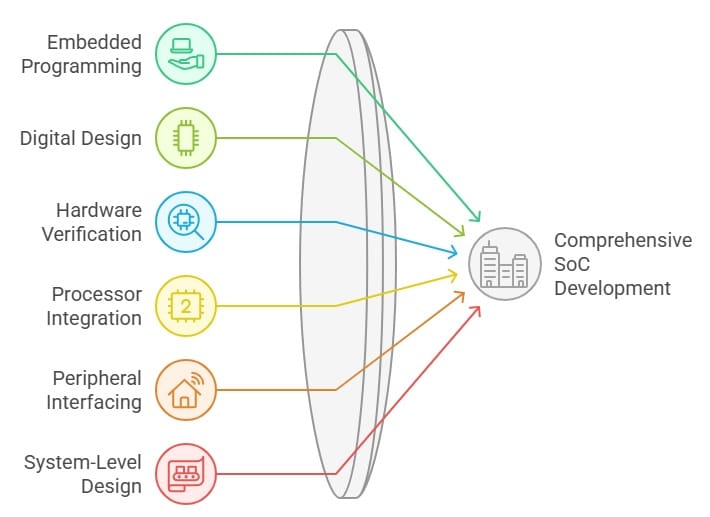
This project involves designing a System on Chip that integrates an embedded processor with multiple peripherals such as memory controllers, communication interfaces, and I/O modules. Students will work on interconnecting various functional blocks within a single chip, using hardware description languages to design, verify, and simulate the complete system. The project helps students understand how complex systems are built through modular integration, which is a vital concept in modern chip design. As one of the most comprehensive VLSI projects for CSE students, it bridges embedded programming, digital design, and hardware verification, offering an end to end view of SoC development.
Why It’s in Demand
In 2025, industries are rapidly adopting integrated solutions that combine multiple functionalities into compact and efficient chips. This integration trend, known as SoC or SiP, drives innovation in mobile devices, automotive systems, and consumer electronics. Companies are seeking professionals skilled in processor integration, peripheral interfacing, and system level design. Among the trending VLSI projects for CSE students, this project stands out because it teaches how to design scalable architectures that balance performance, cost, and power. It equips students with real world skills required for semiconductor, embedded system, and IoT hardware development.
5. Neuromorphic VLSI Circuit Implementation
Brief Description
This project focuses on building brain inspired VLSI circuits that mimic the structure and functionality of biological neural networks. Students will design neuron and synapse models using analog or digital circuits to simulate real time learning and signal processing. The objective is to develop energy efficient architectures capable of adaptive computation similar to human cognition. This is one of the most innovative VLSI projects for CSE students, allowing them to combine concepts from neuroscience, artificial intelligence, and hardware design. Learners gain hands on experience in circuit modeling, system simulation, and optimization techniques used in neuromorphic computing.
Why It’s in Demand
In 2025, neuromorphic computing has emerged as a leading field driving next generation AI hardware. It promises massive improvements in speed and power efficiency compared to traditional architectures. Tech companies are investing heavily in brain inspired chips for robotics, autonomous systems, and edge AI. Among the trending VLSI projects for CSE students, this one stands out for its futuristic potential and interdisciplinary nature. It helps learners understand how to implement adaptive and low power circuits that redefine intelligent computing.
6. High Speed Memory and Cache Design with Low Latency
Brief Description
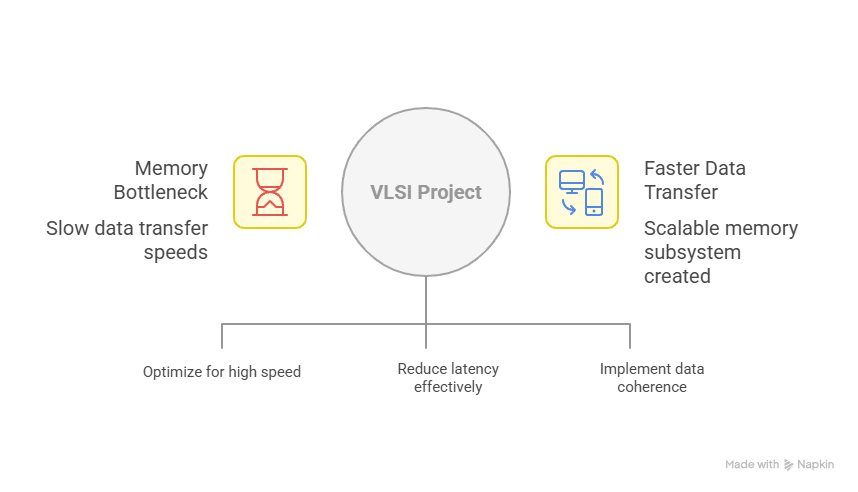
This project focuses on designing memory architectures optimized for high speed access and reduced latency. Students will explore SRAM, DRAM, and cache hierarchy design, emphasizing timing control, data coherence, and energy efficiency. The goal is to create a scalable memory subsystem that supports faster data transfer between processors and storage units. As one of the essential VLSI projects for CSE students, it helps in mastering circuit optimization, architecture design, and memory interfacing techniques critical in modern computing.
Why It’s in Demand
With increasing data intensive workloads in AI, cloud, and high performance computing, memory performance has become a major bottleneck. The demand for faster, low latency cache systems continues to grow as industries push for speed and efficiency. VLSI projects for CSE students that focus on high speed memory design offer direct relevance to today’s semiconductor challenges. This project prepares learners for careers in processor design, hardware acceleration, and data centric system development where performance and efficiency are top priorities.
7. Open Source ASIC Flow Using Tools like OpenLane for Student Tapeout
Brief Description
This project introduces students to the complete Application Specific Integrated Circuit design flow using open source tools such as OpenLane. The objective is to provide hands on experience with design synthesis, floorplanning, placement, routing, and verification using real world workflows. Students learn how to transform RTL designs into physical layouts ready for fabrication, simulating the exact processes followed in professional chip development. This makes it one of the most industry relevant VLSI projects for CSE students, bridging the gap between academic learning and semiconductor manufacturing. Learners gain exposure to end to end chip design methodologies without the cost barriers of commercial software.
Why It’s in Demand
In 2025, open source silicon development is rapidly transforming how chips are designed and fabricated. With initiatives supporting student tapeouts and community driven innovation, there is a strong demand for engineers skilled in open source ASIC flows. This project provides a rare opportunity to understand real design environments, making it one of the most practical VLSI projects for CSE students. It equips them with the skills to contribute to open hardware ecosystems and prepare for roles in design automation and semiconductor R&D.
8. Green VLSI Reconfigurable Design for Energy Efficient Wearables
Brief Description
This project focuses on creating reconfigurable VLSI architectures aimed at reducing energy consumption in wearable devices. Students will design adaptive circuits capable of dynamically adjusting their functionality based on power availability and workload requirements. Techniques like clock gating, voltage scaling, and dynamic reconfiguration will be implemented to achieve sustainable performance. Among innovative VLSI projects for CSE students, this one promotes the integration of green technology concepts into practical chip design for future low power electronics.
Why It’s in Demand
As wearable technology continues to expand in healthcare, fitness, and lifestyle applications, energy efficiency has become a key challenge. The global trend toward sustainable electronics is driving the need for eco friendly, reconfigurable VLSI solutions. Companies are seeking engineers who can design intelligent, power aware circuits for compact devices. This makes it one of the most valuable VLSI projects for CSE students, offering hands on experience in both environmental sustainability and modern chip design innovation.
9. Chiplet Based Multi Module VLSI Architecture for 5G and 6G Communication
Brief Description
This project focuses on designing a modular VLSI architecture using chiplet based integration for high speed communication systems such as 5G and 6G networks. Instead of building a single monolithic chip, students will design smaller chiplets that can be interconnected to perform specific functions like signal processing, modulation, and error correction. This approach enables scalability, cost reduction, and higher performance compared to traditional designs. As one of the most advanced VLSI projects for CSE students, it provides a strong foundation in modular design, interconnect protocols, and high bandwidth communication interfaces. Learners also gain experience with hardware description languages and simulation tools that mirror real world chip development environments.
Why It’s in Demand
In 2025, global communication systems are evolving toward 6G, demanding ultra fast, energy efficient, and reliable hardware solutions. Chiplet architecture has emerged as a major design trend in the semiconductor industry because it allows rapid customization and easier system upgrades. Among trending VLSI projects for CSE students, this one stands out for its direct link to modern telecom innovation. It offers deep insight into how high performance hardware is designed for next generation connectivity, preparing students for careers in wireless communication, semiconductor design, and embedded systems engineering.
10. FPGA Implementation of Real Time Image and Video Processor

Brief Description
This project aims to design a real time image and video processing system using FPGA hardware with a hardware software co design approach. Students will implement operations such as edge detection, filtering, and color transformation using HDL coding for the hardware side while optimizing control logic and algorithms through embedded software. This combination allows efficient parallel processing and high speed performance for visual applications. As one of the most practical VLSI projects for CSE students, it connects their software programming knowledge with hands on hardware development, offering valuable experience in real time signal processing and embedded design.
Why It’s in Demand
With rapid growth in computer vision, robotics, and surveillance systems, real time visual processing is a critical technology. Companies are increasingly shifting toward FPGA based accelerators for faster computation and flexible prototyping. This project is highly relevant for those looking to specialize in image processing hardware, making it one of the most preferred VLSI projects for CSE students. It helps learners understand how software algorithms can be optimized directly on hardware, creating efficient, high performance solutions for multimedia and AI driven systems.
Career & Placement Advantage of Completing a VLSI Project
Completing VLSI projects for CSE students offers a major advantage when building a professional portfolio.
It demonstrates that you have mastered both hardware and software integration, which is a rare and highly valued skill set.
Employers in the semiconductor and embedded industries look for candidates who can think logically, design efficiently, and solve real-world engineering problems.
By showcasing your ability to design, simulate, and optimize circuits, you prove that you can bridge theoretical concepts with practical execution.
These projects highlight analytical thinking, design verification, and coding proficiency, making your resume stand out during campus placements or industry interviews.
Adding VLSI projects for CSE students to your academic record shows recruiters that you are ready to contribute to high-impact, technology-driven roles.
Placement Data and Industry Trends
The semiconductor industry in India is experiencing massive growth, driven by government initiatives and global investments. Reports show a significant hiring surge in design and verification roles, with thousands of job openings emerging each year. Companies are expanding design centers and establishing R&D hubs, creating strong career pathways for skilled graduates. This trend extends beyond traditional IT services, with demand rising for engineers who can handle chip architecture, logic synthesis, and embedded integration. Students with experience in VLSI projects for CSE students have a clear edge because they possess the applied technical understanding that employers prioritize. With the increasing emphasis on chip manufacturing and digital infrastructure, the career potential in VLSI design continues to expand rapidly.
Interview Advice and Career Pathways
During interviews, students should confidently explain their role in the project, tools used, and technical challenges faced. Discussing how specific problems were solved and what performance metrics were achieved demonstrates depth and ownership. Employers value candidates who understand end to end project execution and can articulate both the design and verification phases clearly. Completing VLSI projects for CSE students opens multiple career opportunities including hardware design engineer, verification engineer, embedded systems developer, and R&D associate. Many students even move into startup roles in IoT and chip design, where innovation and interdisciplinary knowledge are highly valued.
Why Choose Elysium Pro for Your VLSI Project
- Elysium Pro, with over 18+ years of experience, 50,000+ successful projects, and expertise across 27+ domains, is a trusted destination for innovative academic and technical guidance.
- It offers specialized VLSI projects for CSE students that blend theoretical concepts with practical design experience, focusing on cutting-edge domains like AI, IoT, 5G, and energy-efficient computing.
- Each project package includes a complete set of titles, abstracts, source code, documentation, and viva support, ensuring students have everything required for academic success.
- Through expert mentorship, VLSI projects for CSE students are guided step-by-step — from topic selection to project completion — with internship opportunities that provide valuable industry exposure.
- These VLSI projects for CSE students stand out for combining real-world industry insights, hands-on learning, and technical innovation, empowering students to build strong foundations for future semiconductor careers.
Frequently Asked Questions
1.Do CSE students need strong ECE background for VLSI?
No, basic knowledge of digital electronics and logic design is enough. Our training bridges software and hardware skills for CSE students.
2. How long does a typical VLSI project take?
Most VLSI projects for CSE students take 8–12 weeks, covering design, simulation, and verification phases.
3. What if I don’t have ASIC access—can I still do VLSI on FPGA?
Yes, projects can be implemented using FPGA kits or open-source tools to simulate ASIC behavior effectively.
4. How to choose a project that aligns with placements?
Select VLSI projects for CSE students related to trending areas like AI chips, IoT, or low-power design that match semiconductor job roles.
5. Can the project lead to publication or patent?
Yes, innovative designs can be submitted to IEEE journals or filed as student-level patents with mentor guidance.
Conclusion
In 2025, VLSI projects for CSE students stand out as a smart choice for those aiming to merge innovation with practical industry relevance.
These projects align with the fast-growing fields of AI hardware, IoT, 5G, and low-power chip design, giving students a clear competitive edge in both academia and employment.
By working on real-time circuits and hardware architectures, students not only gain deep technical insight but also enhance their resume with hands-on engineering experience.
Starting early and choosing the right topic ensures a strong foundation for future placements or research opportunities.
For expert guidance, Elysium Pro provides structured mentorship, access to modern tools, and personalized support throughout the development process.
So, if you are ready to bridge software intelligence with hardware innovation, begin your journey with VLSI projects for CSE students today and turn your academic project into a gateway for a promising semiconductor career.