
final year projects near me
October 7, 2026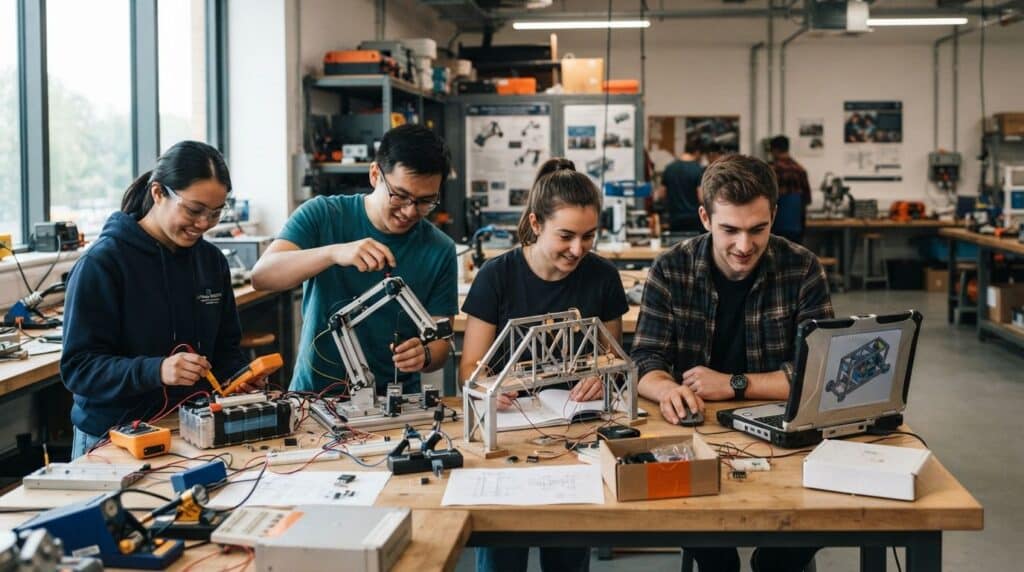
Introduction
For most students, the final year project is the biggest engineering task of the degree. It carries serious marks and fills a full semester, and it often becomes the first topic in placement interviews. So choosing among final year engineering projects deserves more thought than picking the first title on a list.
The challenge is balance. Your project should be impressive, yet realistic. It should also match your branch and budget, while still leaving time for testing and a solid report.
In this guide, Elysiumpro shares 30 project ideas across six branches and a scoring method for choosing your topic. It also explains the typical marking rubric and a sample budget. Finally, you will see how to turn a good project into a paper or patent.
What Are Final Year Engineering Projects?
Final year engineering projects are major academic projects in which students apply their branch knowledge to design, build, test and document a working solution. They usually run for one or two semesters and are assessed through reviews, a report and a viva.
- At a glance: final year engineering projects
- Duration: 16–30 weeks across one or two semesters
- Team size: usually 1–4 students
- Types: hardware, software, simulation, fabrication or hybrid
- Key outputs: working prototype or model, test results, project report and presentation
- Assessment: periodic reviews, final demo, report evaluation and viva voce
- Common tools: MATLAB/Simulink, Arduino and ESP32, SolidWorks, ANSYS, AutoCAD, Python
Mini project vs major project: what is the difference?
A mini project is short and demonstrates one concept. In contrast, the major project needs a literature survey, full design documentation, testing and a formal evaluation.
How Do You Choose Final Year Engineering Project Topics?
Choose final year engineering project topics by scoring each shortlisted idea against five weighted criteria. This turns a gut decision into a clear, defensible choice.
| Criterion | Weight | Question to ask |
|---|---|---|
| Career fit | 25 | Does it build skills for the job or higher studies I want? |
| Feasibility | 25 | Can my team finish it with our current skills in time? |
| Originality | 20 | Does it improve on existing work in a visible way? |
| Cost | 15 | Can we afford the components, software and fabrication? |
| Availability | 15 | Are the parts, data and lab equipment easy to get? |
Worked example: an EEE student scoring three topics Rate each topic from 1 to 5, multiply by the weight and add up the results out of 500.
| Topic | Career fit | Feasibility | Originality | Cost | Availability | Total (out of 500) |
|---|---|---|---|---|---|---|
| Solar MPPT charge controller | 4 | 5 | 3 | 4 | 5 | 420 |
| EV battery management system | 5 | 4 | 4 | 3 | 4 | 410 |
| Wireless power transfer charger | 3 | 3 | 4 | 3 | 3 | 320 |
The MPPT controller wins narrowly. However, if an EV-industry job is the student's top priority, the battery management system is a sensible choice, because the gap is only 10 points. The wireless charger drops out clearly.
What Are the Best Final Year Engineering Project Ideas by Branch?
The best final year engineering project ideas pair a current technology with a practical problem. Below are 30 final year engineering projects, five per branch, with key components and difficulty levels.
Electronics and Communication Engineering (ECE)
| Project | What it does | Key components or tools | Level |
|---|---|---|---|
| Smart helmet with accident alert | Detects crashes and sends GPS location by SMS | ESP32, accelerometer, GPS, GSM module | Intermediate |
| LoRa-based farm sensor network | Sends soil and weather data over long range | LoRa modules, sensors, cloud dashboard | Intermediate |
| Low-power 8-bit ALU design | Reduces power in a basic processor block | Verilog, Xilinx Vivado | Advanced |
| ECG signal denoising | Removes noise from heart signals | MATLAB, digital filters | Intermediate |
| Vehicle-to-vehicle warning system | Alerts nearby vehicles about sudden braking | RF modules, microcontrollers | Advanced |
Electrical and Electronics Engineering (EEE)
| Project | What it does | Key components or tools | Level |
|---|---|---|---|
| Solar MPPT charge controller | Maximises solar panel output | Buck converter, microcontroller, MATLAB | Intermediate |
| EV battery management system | Monitors cell voltage, temperature and charge | Li-ion cells, BMS IC, Arduino | Advanced |
| Smart energy meter with theft detection | Tracks usage and flags tampering | Current sensors, ESP32, IoT platform | Intermediate |
| Automatic power factor correction | Improves power factor in small loads | Capacitor bank, relays, microcontroller | Intermediate |
| Grid-tied inverter simulation | Models inverter control for grid connection | MATLAB/Simulink | Advanced |
Mechanical Engineering
| Project | What it does | Key components or tools | Level |
|---|---|---|---|
| Pick-and-place robotic arm | Sorts objects by colour | Servo motors, Arduino, 3D-printed parts | Intermediate |
| Solar-powered crop dryer | Dries produce using solar heat | Sheet metal, fans, temperature sensors | Beginner |
| FEA of an EV brake disc | Compares materials for heat and stress | SolidWorks, ANSYS | Intermediate |
| Regenerative braking for bicycles | Recovers energy while braking | Hub motor, battery, controller | Advanced |
| Automatic pneumatic punching machine | Punches sheets with less manual effort | Pneumatic cylinder, solenoid valve, PLC | Intermediate |
Civil Engineering
| Project | What it does | Key components or tools | Level |
|---|---|---|---|
| Structural health monitoring of a bridge model | Detects strain and vibration changes | Strain gauges, accelerometers, data logger | Advanced |
| Concrete with partial plastic-waste aggregate | Tests strength with recycled plastic | Lab testing, compression machine | Beginner |
| GIS flood-risk mapping | Maps high-risk zones in a district | QGIS, rainfall and elevation data | Intermediate |
| Rainwater harvesting design for a campus | Sizes tanks and recharge pits | AutoCAD, rainfall data | Beginner |
| Smart traffic signal timing study | Optimises signal timing at a junction | Traffic surveys, simulation software | Intermediate |
Computer Science and IT
| Project | What it does | Key components or tools | Level |
|---|---|---|---|
| Crop disease detection | Classifies leaf diseases from photos | Python, TensorFlow | Intermediate |
| Phishing URL detector | Flags suspicious links | Python, scikit-learn | Intermediate |
| College event management portal | Handles registrations and certificates | Spring Boot, React, MySQL | Intermediate |
| Academic certificate verification | Verifies degrees on a blockchain | Solidity, Ethereum testnet | Advanced |
| Serverless image processing pipeline | Resizes and tags uploads automatically | AWS Lambda, S3 | Intermediate |
For 40 more CSE ideas with stacks and difficulty levels, see our guide to final year projects for computer science.
Interdisciplinary projects
| Project | What it does | Branches involved | Level |
|---|---|---|---|
| Solar-powered EV charging kiosk | Charges two-wheelers with solar power and a payment app | EEE, ECE, CSE | Advanced |
| Smart irrigation with ML scheduling | Waters crops using sensors and weather forecasts | ECE, CSE, Civil | Intermediate |
| Autonomous campus delivery robot | Delivers small items across campus | Mechanical, ECE, CSE | Advanced |
| Air quality monitoring drone | Maps pollution at different heights | Mechanical, ECE | Advanced |
| Earthquake early-warning prototype | Detects tremors and sends alerts | Civil, ECE, CSE | Advanced |
How Are Final Year Engineering Projects Evaluated?
Most universities evaluate final year engineering projects across six areas: problem definition, design, implementation, results, report and viva. Exact weightings vary by university, so always check your department's rubric. A typical split looks like this.
| Evaluation area | Typical marks (out of 100) | What examiners look for |
|---|---|---|
| Literature survey and problem definition | 10 | Clear gap, relevant recent sources |
| Design and methodology | 20 | Block diagrams, calculations, justified choices |
| Implementation | 25 | Working prototype, model or software |
| Results and testing | 15 | Measured data, comparison with existing work |
| Project report | 15 | Structure, clarity, correct citations |
| Presentation and viva | 15 | Confident demo, clear answers from every member |
Where do students lose the most marks?
Students most often lose marks in results and the viva. Therefore, record test data throughout the build, and make sure every team member can explain the full system, not just their own part.
How Does Engineering Final Year Project Development Work?
Engineering final year project development follows five phases, whether you build hardware or software. The main difference is where the time goes: hardware needs procurement and assembly, while software needs more coding and testing iterations.
| Phase | Weeks (of 20) | Hardware project focus | Software project focus |
|---|---|---|---|
| 1. Research and proposal | 1–3 | Survey papers, select components | Survey papers, choose the stack |
| 2. Design | 4–6 | Circuit or CAD design, simulation | Architecture, UML and database design |
| 3. Build | 7–13 | Procurement, PCB or fabrication, assembly | Module coding, weekly commits |
| 4. Testing | 14–16 | Calibration, load and safety tests | Unit, integration and user testing |
| 5. Documentation and viva prep | 17–20 | Report, demo video, slides | Report, demo video, slides |
Why simulate before you build?
Simulation in MATLAB, Proteus or ANSYS catches design errors cheaply. As a result, you buy the right components the first time and avoid burning boards or wasting material.
How Much Does a Final Year Engineering Project Cost?
Among final year engineering projects, software builds often cost little beyond internet and free cloud tiers. Hardware and fabrication projects, however, usually cost ₹3,000–20,000 per team in components and materials, depending on complexity.
Worked example: budget for an EV battery management system (EEE)
| Item | Sample cost (₹) |
|---|---|
| 4 Li-ion cells × ₹350 | 1,400 |
| BMS module | 1,200 |
| Microcontroller board (Arduino or ESP32) | 700 |
| Voltage, current and temperature sensors | 900 |
| Custom PCB fabrication | 1,500 |
| Enclosure, connectors and wiring | 800 |
| Subtotal | 6,500 |
| Contingency (15%) for damaged or replacement parts | 975 |
| Total | 7,475 |
For a three-member team, that is about ₹2,490 per student. Also, buy sensors and modules early, because delivery delays often eat into testing time.
Should You Use Final Year Engineering Project Centers?
Final year engineering project centers are helpful when they offer mentoring, lab access and tool training while you do the building. However, avoid any centre that sells ready-made final year engineering project solutions to submit as your own. That counts as academic misconduct at most universities.
A good centre helps you scope a topic, reviews your design and debugs with you. It also runs mock vivas. For a detailed checklist on choosing one, see our guide to final year projects near me.
Can Your Project Become a Paper or Patent?
Yes. Many strong final year engineering projects go on to become conference papers, hackathon entries or patent applications. These add real weight to your resume and to higher-studies applications.
- Conference paper. Write up your problem, method and results, then submit to a student or regional IEEE conference. Your guide can help you choose one with a suitable deadline.
- National events such as the Smart India Hackathon invite solutions to real problem statements, and a working project gives you a head start.
- If your design is genuinely new, you can file a provisional application with the Indian Patent Office. It secures a filing date while you refine the invention.
Common Mistakes to Avoid
- Choosing a topic only because it sounds advanced. Score it for feasibility first.
- Skipping simulation. Building straight away often wastes components and weeks.
- Ordering parts late. Order during the design phase, not the build phase.
- Not recording test data. Results carry marks; log measurements from day one.
- Uneven team knowledge. Every member must understand the whole system for the viva.
- Buying a ready-made project. It risks disciplinary action and leaves you exposed in the viva.
Conclusion
The best final year engineering projects are realistic, well-tested and clearly explained. Score your topic ideas, pick one from the 30 above or adapt it, then follow the five-phase plan with a sensible budget. Record results as you go, and your report and viva will come together smoothly.
If you want expert mentoring, lab access and viva preparation while you build your project yourself, Elysiumpro supports students across ECE, EEE, Mechanical, Civil and CSE. Book a free project consultation to get started.