
Final Year Engineering Projects
October 7, 2026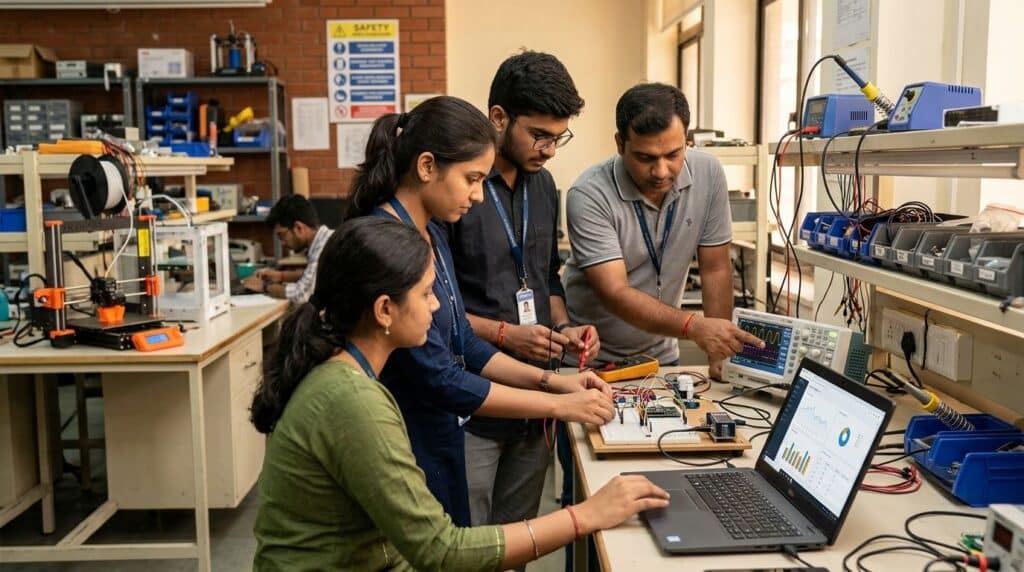
Introduction
Your final-year project is often the first thing interviewers ask about. It shows whether you can take an idea, build it and explain it. No wonder so many students search for an engineering project center near me as soon as final year begins.
However, the choice matters more than most students expect. Some centers teach you to build a real system. Others simply hand over a finished kit and a copied report. As a result, students sometimes pass the submission but struggle badly in the viva or in job interviews.
This guide helps you choose well. First, you will see what a project center does and which services matter. Next, you will get 7 practical checks, a clear comparison of guided and ready-made projects, and a sample timeline. Finally, you will learn about fees and common mistakes.
At Elysium Academy, we guide final-year students every semester, and these are the questions they ask us on their first visit.
What Is an Engineering Project Center?
An engineering project center is a specialised facility where students get expert guidance, lab access and training to design, build, test and document their academic projects. Its job is to help you complete a project you understand and can defend.
- At a glance: engineering project center
- Who it serves: B.E., B.Tech, M.E., M.Tech, diploma and MCA students.
- Core services: topic selection, design guidance, development support, testing, report writing help and viva preparation.
- Common domains: embedded systems, IoT, AI and ML, VLSI, power electronics, robotics, mechanical CAD and analysis, civil design, web and mobile apps.
- Typical duration: one to two semesters, aligned with college reviews.
- Outcome: a working project, a report you understand and confidence for the viva.
Why Choose an Engineering Project Center Near Me?
An engineering project center near me saves travel time, allows frequent face-to-face reviews and gives you hands-on lab access whenever your project needs debugging. Because final-year schedules are tight, being close matters.
Frequent in-person reviews
Projects rarely work the first time. A nearby center lets you drop in after class, show your circuit or code, and get feedback the same day. Consequently, small problems do not grow into missed deadlines.
Hardware and lab access
Many projects need oscilloscopes, soldering stations, development boards, 3D printers or licensed software. A local center gives you access without buying expensive tools yourself.
Alignment with your college
Finally, a local engineering project center in my area often knows the review formats and guidelines of nearby colleges and universities. As a result, it can help you prepare for each review stage with the right documents.
What Services Should a Good Project Center Offer?
A good project center offers six core services: topic selection, technical guidance, development support, testing, documentation help and viva preparation. It should also offer skill training, so you understand every part of your project.
| Branch | Popular project domains | Common tools |
|---|---|---|
| ECE / EEE | Embedded systems, IoT, VLSI, power electronics, signal processing | Arduino, ESP32, Raspberry Pi, MATLAB, Xilinx Vivado |
| CSE / IT / MCA | AI and ML, web and mobile apps, cybersecurity, cloud | Python, TensorFlow, React, Django, Android Studio |
| Mechanical | Design and analysis, automation, robotics, thermal systems | SolidWorks, ANSYS, AutoCAD, 3D printing |
| Civil | Structural design, green buildings, transport planning | STAAD.Pro, AutoCAD, Revit |
How Do You Find the Best Engineering Project Center Near Me?
To find the best engineering project center near me, compare local options on mentor expertise, domain coverage, lab facilities, past student work, integrity policy, fee transparency and reviews. Visiting two or three centers in person is the fastest way to decide.
Use these 7 checks:
If a center promises a "complete project in one week" with no involvement from you, walk away.
Guided Development vs Ready-Made Projects: What Is the Difference?
Guided development means you build the project yourself with expert support, while a ready-made project is bought finished and submitted as your own. Only guided development builds real skills and holds up in a viva.
| Factor | Guided engineering project development | Ready-made project |
|---|---|---|
| Who does the work | You, with mentor support | Someone else |
| Viva performance | Confident, because you understand every part | Risky; examiners spot gaps quickly |
| Plagiarism risk | Low, with original code and a properly cited report | High; reports and code are often reused |
| Skills gained | Design, coding, testing, documentation | Very few |
| Interview value | Strong talking point with real stories | Weak or harmful if questioned |
| Academic integrity | Meets college rules | May breach college and university policies |
Many universities run similarity checks on project reports, and the UGC regulations on academic integrity set rules against plagiarism in higher education. Therefore, guided work is not only more useful; it is also safer.
What Does a Final-Year Project Timeline Look Like?
A typical final-year project runs across two semesters, with four or five college reviews, from topic approval to the final viva. Below is a worked example: an IoT-based smart irrigation system built by a team of three ECE students.
| Phase | Approximate timing | Student work | Review output |
|---|---|---|---|
| Topic and literature survey | Weeks 1–3 | Pick the problem, read 10–15 papers, define objectives | Zeroth review: abstract and base paper |
| Design | Weeks 4–6 | Block diagram, circuit design, component list | Review 1: design and methodology |
| Development | Weeks 7–14 | Build the sensor node with an ESP32, write firmware and a web dashboard | Review 2: partial demo |
| Testing | Weeks 15–18 | Field test on a small garden plot, log data | Review 3: results and analysis |
| Documentation and viva | Weeks 19–22 | Write the report, prepare slides, mock viva | Final review and viva voce |
Here is an illustrative result from a project like this. During a four-week field test, the system watered only when soil moisture fell below a set threshold. Compared with a fixed daily schedule on a similar plot, it used about 30% less water while keeping the plants healthy. Because the team measured this themselves, they could explain every number in the viva.
For this reason, always plan a real test and record results. Numbers turn a good project into a memorable one.
How Much Does an Engineering Project Center Near Me Charge?
An engineering project center near me in India typically charges about ₹3,000 to ₹10,000 for mini projects and about ₹8,000 to ₹40,000 for final-year major projects. Hardware components are often billed separately.
Several factors change the cost:
- Project type: hardware projects cost more than software-only ones because of components and lab time.
- Domain complexity: VLSI, robotics and advanced AI projects usually need more mentoring hours.
- Team size: some centers charge per team, others per student.
- Extra services: paper publication support, internship certificates and skill training may cost extra.
Above all, ask for an itemised quote. A clear breakdown helps you compare centers fairly and avoid surprise charges later.
Common Mistakes to Avoid
The biggest mistake is choosing an engineering project center near me only because it is cheapest or promises the fastest delivery. Instead, judge it on mentors, labs and integrity. Also watch for these traps:
- Starting too late. Leaving the project until the last semester causes rushed work and weak results.
- Picking a trendy topic you do not understand. Choose a problem you can explain clearly in the viva.
- Letting one teammate do everything. Examiners question every member, so share the work.
- Skipping testing. Without measured results, your report looks thin.
- Copying reports. Similarity checks catch reused text. Write in your own words and cite sources properly.
Interdisciplinary projects
The right engineering project center near me does more than help you submit a project. It helps you build one you understand, can defend and can talk about in interviews. To sum up, check mentors, domains, labs, integrity and fees, and start early.
Most importantly, choose guidance over shortcuts. The skills you gain in final year often shape your first job.
Ready to begin? Elysium Academy offers guided engineering project development, lab access and viva preparation for all major branches. Book a free project consultation at your nearest center today.