
MERN Projects
October 28, 2026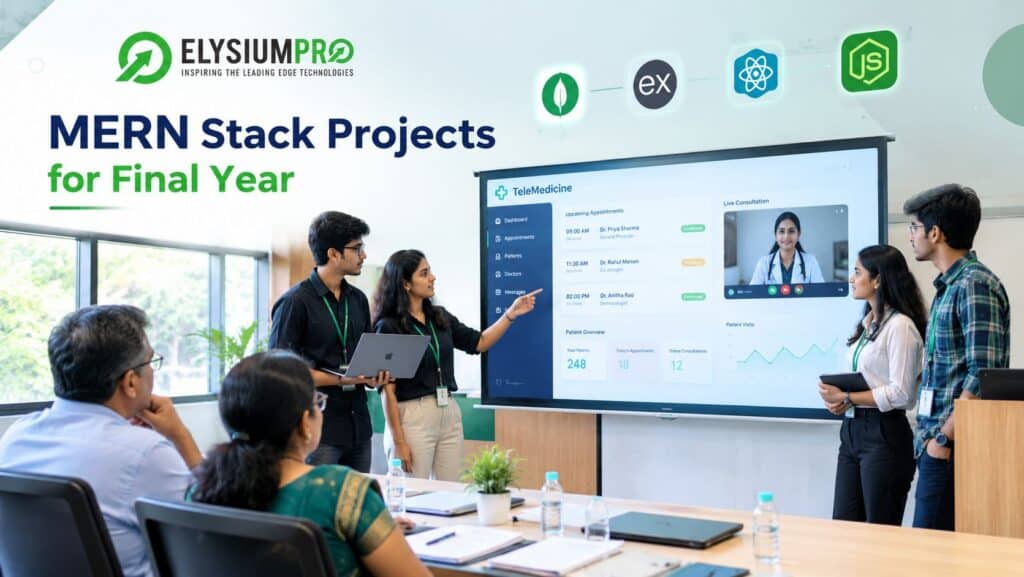
Introduction
Your final year project is more than a requirement for your degree. In fact, it is often the first thing recruiters ask about in placement interviews. That is why choosing the right mern stack projects for final year matters so much. MERN lets you build a complete, modern web app with one language, and it shows employers you can work across the full stack.
However, a final year project needs more than working code. It needs a clear problem, a novel feature, solid documentation and a confident viva. This guide covers all of it, with 15 domain-wise ideas, an abstract-to-viva plan, a sample architecture and a worked evaluation example. It draws on the Elysiumpro team's experience guiding computer science and engineering students through their major projects across India.
What Makes MERN Stack Projects for Final Year Different?
MERN stack projects for final year go beyond practice apps because examiners judge the problem, the design and your understanding, not just the output. A to-do app proves you can code. In contrast, a major project proves you can analyse a need, design a system and defend your choices.
- At a glance: what a final year MERN major project needs
- Problem statement: a real user need, backed by a short literature survey
- Novelty: at least one feature beyond CRUD, such as AI, real-time sync, geolocation or IoT
- Scale: three or more user roles and five to eight modules
- Design artefacts: SRS, ER or schema diagram, DFD and UML diagrams
- Proof: test cases, a live deployment, a project report and a viva demo
Why Choose MERN for Your Final Year Major Project?
MERN is a strong choice because it is in demand, free to use and fast to deploy. As a result, your project doubles as a portfolio piece for placements.
What Are the 15 Best MERN Stack Projects for Final Year?
The 15 ideas below are grouped by domain, and each includes a novelty feature examiners look for. Pick a domain you care about, because you will spend a whole semester on it.
Healthcare and Wellness
- Telemedicine Platform: Patients book video consultations, and doctors issue e-prescriptions as PDFs. Novelty: symptom-based doctor recommendation.
- Mental Health Journal With Mood Analytics: Users log daily entries and view mood trends. Novelty: sentiment analysis through an NLP API with counsellor alerts.
- Blood and Organ Donor Network: Hospitals find nearby donors in seconds. Novelty: MongoDB geospatial queries with emergency SMS alerts.
Education and Campus
- Smart Campus ERP: Attendance, timetables, fees and results across four user roles. Novelty: attendance-shortage prediction.
- AI-Proctored Online Examination System: Timed tests with auto-grading. Novelty: webcam snapshots and tab-switch detection.
- Alumni Mentorship Portal: Students connect with alumni for guidance and referrals. Novelty: skill-based mentor matching.
Commerce and Fintech
- Multi-Vendor E-Commerce Platform: Seller dashboards, orders, reviews and payments. Novelty: product recommendations from purchase history.
- Personal Finance Manager: Users import bank statements and set budgets. Novelty: next-month spending forecasts.
- Campus Book Exchange: Students list, chat about and swap used textbooks. Novelty: campus pickup scheduling with reminders.
Social Impact and Community
- Real-Time Collaborative Whiteboard: Teams draw and plan together in shared rooms. Novelty: live canvas sync through Socket.IO.
- Civic Complaint Reporting Portal: Citizens report potholes or broken lights with photos and location. Novelty: map-based status tracking for officials.
- Volunteer and NGO Event Platform: NGOs post events, and volunteers sign up. Novelty: automatic hour tracking and certificates.
Agriculture and Smart City
- Farmer-to-Consumer Marketplace: Farmers list produce directly for local buyers. Novelty: price-trend charts and local delivery routing.
- Smart Parking Reservation System: Drivers book slots in advance. Novelty: time-based pricing and QR-code entry.
- IoT Energy Monitoring Dashboard: ESP32 sensors send power readings to a Node.js API. Novelty: live charts and overuse alerts, ideal for ECE and EEE teams.
Which MERN Stack Major Project Ideas Suit Your Team?
The right idea depends on your team's size, skills and timeline. Among mern stack projects for final year, the table below compares difficulty and the standout technology each one needs.
| # | Project | Difficulty | Team size | Standout tech |
|---|---|---|---|---|
| 1 | Telemedicine Platform | Advanced | 3–4 | WebRTC, PDF generation |
| 2 | Mental Health Journal | Intermediate | 2–3 | NLP sentiment API, charts |
| 3 | Donor Network | Intermediate | 2–3 | Geospatial queries, SMS API |
| 4 | Smart Campus ERP | Advanced | 3–4 | Role-based access, reports |
| 5 | AI-Proctored Exam System | Advanced | 3–4 | Webcam API, browser events |
| 6 | Alumni Mentorship Portal | Intermediate | 2–3 | Matching logic, chat |
| 7 | Multi-Vendor E-Commerce | Advanced | 3–4 | Payments, recommendations |
| 8 | Personal Finance Manager | Intermediate | 2 | CSV parsing, forecasting |
| 9 | Campus Book Exchange | Beginner–Intermediate | 2 | Chat, reminders |
| 10 | Collaborative Whiteboard | Advanced | 2–3 | Socket.IO, canvas |
| 11 | Civic Complaint Portal | Intermediate | 2–3 | Maps API, image uploads |
| 12 | Volunteer and NGO Platform | Beginner–Intermediate | 2 | PDF certificates |
| 13 | Farmer-to-Consumer Marketplace | Intermediate | 3 | Charts, delivery routing |
| 14 | Smart Parking System | Intermediate | 2–3 | QR codes, pricing rules |
| 15 | IoT Energy Dashboard | Advanced | 3–4 | ESP32, MQTT or HTTP, live charts |
If your team is small, choose an intermediate idea and add one advanced feature. You show depth without risking an unfinished build.
How Do You Plan a MERN Project From Abstract to Viva?
You plan a final year MERN project by fixing the problem and scope first, then designing, building, testing and documenting in that order. A 16-week semester breaks down well into these steps.
- Write the abstract (week 1). State the problem, the users, the proposed solution and the novelty in about 250 words.
- Survey existing work (week 2). Review five to ten similar apps or papers, and note the gap your project fills.
- Prepare the SRS (week 3). List functional and non-functional requirements for each user role.
- Design the system (weeks 4–5). Draw the architecture, MongoDB schema, DFD and UML use-case diagrams.
- Build the backend (weeks 6–8). Create Mongoose models, Express routes, JWT authentication and role checks.
- Build the frontend (weeks 9–11). Develop React pages and components, then connect them to the API.
- Test and deploy (weeks 12–13). Write test cases, fix bugs and deploy to MongoDB Atlas, Render and Vercel.
- Write the report (weeks 14–15). Cover every chapter your university template requires, with screenshots.
- Rehearse the viva (week 16). Prepare a five-minute demo script and practise likely questions.
What Should Your MERN Project Architecture Include?
A solid MERN architecture separates the React client from the Express server and follows the MVC pattern on the backend. This structure makes your code easier to test, explain and extend.
project-root/
├── client/ # React app (Vite)
│ └── src/
│ ├── components/ # reusable UI pieces
│ ├── pages/ # one file per screen
│ ├── context/ # auth and global state
│ └── api/ # Axios calls to the server
└── server/ # Node.js + Express API
├── config/ # database connection
├── models/ # Mongoose schemas
├── controllers/ # business logic
├── routes/ # REST endpoints
├── middleware/ # auth, roles, error handling
└── .env # secrets (never commit)
In addition, include these essentials in every MERN stack web application project:
- Authentication: bcrypt password hashing and JWT access tokens.
- Authorisation: middleware that checks each user's role before protected routes run.
- Validation: schema rules in Mongoose plus request checks with a library such as Joi or express-validator.
- Error handling: one central error middleware that returns clear, consistent messages.
Where Can You Get MERN Stack Final Year Projects With Source Code?
You can get MERN stack final year projects with source code from GitHub, official tutorials and guided project providers. However, source code should be your starting point, never your final submission.
Reliable Sources
- GitHub: Search the mern-stack topic and check stars, recent commits, the licence and the README.
- Official learning resources: React docs, MongoDB University and the Express guides include working, well-explained examples.
- Guided providers: Elysiumpro supplies documented MERN source code with abstracts, reports, PPTs and viva preparation.
Keeping Your Project Original
First, run the code and trace one request from the React form to the database. Next, add your own novelty feature and at least one new module. Finally, write the report in your own words, because most universities run plagiarism checks on documentation.
How Are MERN Stack Projects for Final Year Evaluated?
MERN stack projects for final year are usually evaluated on problem definition, design, implementation, testing, documentation and the viva. The rubric below is a typical sample; your university's weights may differ.
Worked example: Telemedicine Platform (team of three)
- Roles: patient, doctor and admin.
- Data: 9 MongoDB collections, including users, doctors, slots, appointments, prescriptions and payments.
- API: 34 REST endpoints protected by JWT and role middleware.
- Novelty: WebRTC video consultations and symptom-based doctor suggestions.
- Testing: 42 documented test cases, covering invalid logins, double bookings and expired tokens.
| Criterion | Sample weight | What examiners check |
|---|---|---|
| Problem and novelty | 15% | Real need, literature gap, unique feature |
| System design | 15% | Architecture, schema, DFD and UML diagrams |
| Implementation | 30% | Working modules, code quality, security |
| Testing | 10% | Test cases, edge cases, bug log |
| Documentation | 15% | Report quality, formatting, originality |
| Presentation and viva | 15% | Demo flow and depth of understanding |
What Common Mistakes Should You Avoid?
Most lost marks come from planning and documentation gaps, not from weak code. Watch out for these:
- Choosing a project with no novelty. A plain CRUD app rarely scores well at final year level.
- Skipping the design phase. Missing diagrams hurt both your report and your viva.
- Committing secrets to GitHub. Keep database URIs and JWT keys in .env files.
- Ignoring role-based access. Every protected route should check the user's role on the server.
- Demoing on localhost only. A live deployment proves your project works outside your laptop.
- Memorising instead of understanding. Examiners often ask you to trace or change code live.
Conclusion: Start Your MERN Stack Projects for Final Year With a Plan
The best mern stack projects for final year pair a real problem with one standout feature, a clean architecture and strong documentation. So shortlist two ideas from the 15 above, check them against your team's skills and follow the abstract-to-viva plan. Above all, make sure you understand every route, schema and component you present. If you want documented source code, report support or one-to-one guidance, the Elysiumpro team can help from abstract to final demo. Explore the Elysiumpro MERN major project list today and lock in your idea early.