
Final Year Project Development Services
October 20, 2026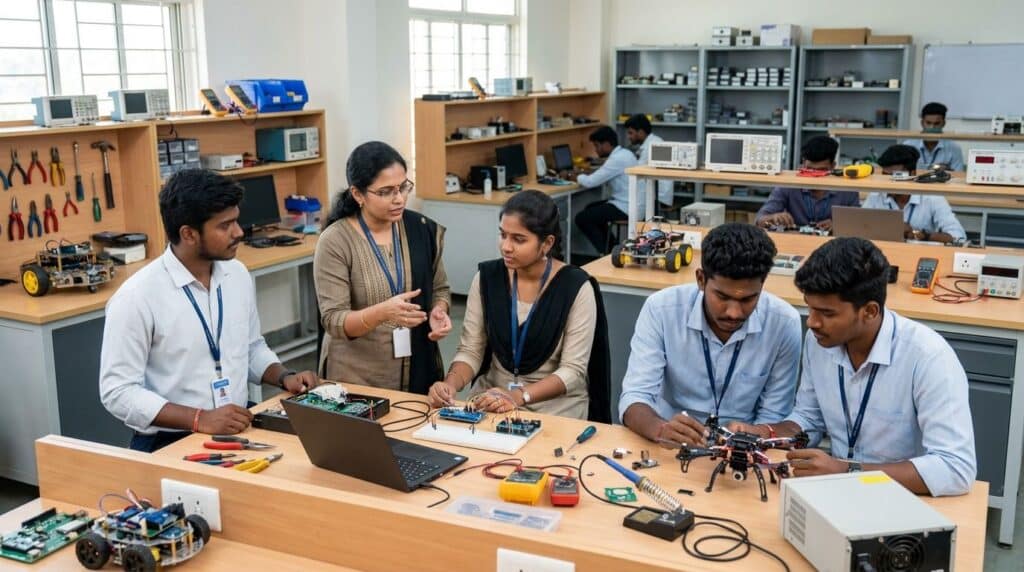
Introduction
Some students work best alone with a laptop. Many others learn faster with a mentor beside them, the right tools on the bench, and classmates working on similar problems. That is why so many engineering students look for a final year project centre during their last year.
However, project centres vary widely in quality. Some have experienced mentors and well-stocked labs, while others simply sell ready-made projects. In this guide, you will learn what a good centre offers, how to find one near you, nine checks to compare centres, what a typical training programme looks like, and how much you should expect to pay.
At Elysiumpro, we run hands-on project guidance for engineering students, and this guide reflects what students and parents ask us most during centre visits.
What Is a Final Year Project Centre?
A final year project centre is a dedicated facility where final year students receive mentoring, technical training, lab access, and hardware support while building their academic projects. It combines classroom-style training with hands-on lab work, so students can learn, build, and test in one place.
- What it offers: Mentors, labs, hardware, computing resources, training, and viva practice.
- Who it serves: B.E./B.Tech, M.E./M.Tech, MCA, and BCA students.
- Typical programme length: 10–14 weeks.
- Typical visit pattern: 2–3 sessions per week.
- Golden rule: The centre guides you; you build and explain the project.
A final year project guidance centre differs from a purely online service because you can work on real equipment under supervision.
Why Join an Engineering Final Year Project Centre?
An engineering final year project centre gives you structure, expert help, and equipment that your college lab may not always provide. Key benefits include:
As a result, students who struggle with self-discipline or hardware often benefit most from a centre.
What Facilities Should the Best Final Year Project Centre Have?
The best final year project centre has the right mix of people, equipment, and resources for your domain. Check these facilities during your visit.
| Facility | What to look for | Why it matters |
|---|---|---|
| Domain mentors | Experienced engineers for your specific area, such as ML or embedded systems | Quality guidance depends on real expertise |
| Electronics lab | Soldering stations, multimeters, oscilloscopes, power supplies | Essential for ECE, EEE, and IoT projects |
| Component stock | Common sensors, microcontrollers, and modules in stock | Prevents weeks of waiting for parts |
| Computing systems | Updated PCs, plus GPU access for AI projects | Faster training and testing |
| Research access | Access to IEEE papers and reference books | Supports your literature review |
| Demo space | A quiet area for practice presentations | Builds viva confidence |
| Batch size | Small groups, ideally under 10 students per mentor session | More personal attention |
How Do You Find a Final Year Project Centre Near Me?
The fastest way to find a final year project centre near me is to search on Google Maps, then check ratings, recent reviews, and photos before visiting. Add your city or branch to the search for better results, such as "IoT project centre in [your city]."
Next, ask seniors and classmates which centres they used and whether they would choose them again. In addition, look at each centre's Google Business Profile for opening hours, photos of real labs, and how they respond to negative reviews. Finally, shortlist two or three centres that are easy to reach, because you may visit several times a week.
This approach keeps the project yours, and it is how ethical final year project development services should work. For a full student-side walkthrough of every stage, read our guide to final year project solutions.
How Do You Choose the Best Final Year Project Centre? 9 Proven Tips
Choosing the best final year project centre comes down to checking mentors, facilities, process, and honesty. Use these nine tips during your visits.
- Meet the mentors. Ask about their qualifications and the projects they have guided in your domain.
- Tour the lab. Look for working equipment, organized component stock, and students actively building.
- Attend a demo session. A free trial class shows how well mentors teach.
- Ask about batch size. Smaller groups mean more time with your mentor.
- Check the schedule. Make sure session timings fit around your college hours.
- Confirm the student-built approach. A good centre insists that you write the code and the report.
- Review past student work. Ask to see demos or reports, with names removed.
- Clarify support after submission. Help should continue until your viva and any rework.
- Get fees in writing. Ask for a detailed fee breakdown and refund terms before paying.
What Does a Final Year Project Training Centre Programme Look Like?
A final year project training centre programme usually runs for 10 to 14 weeks, with two or three lab sessions each week. Here is an illustrative 12-week schedule based on how Elysiumpro structures its programmes, using two 3-hour sessions per week.
| Weeks | Focus | Sessions | Lab hours |
|---|---|---|---|
| 1–2 | Topic finalization and tool training | 4 × 3 hours | 12 |
| 3–4 | Design and literature review guidance | 4 × 3 hours | 12 |
| 5–9 | Guided implementation in the lab | 10 × 3 hours | 30 |
| 10 | Testing and results | 2 × 3 hours | 6 |
| 11 | Report review | 2 × 3 hours | 6 |
| 12 | Mock viva and demo practice | 2 × 3 hours | 6 |
| Total | — | 24 sessions | 72 |
In this plan, half of the 72 lab hours go to hands-on implementation and testing. Most students also spend about 5 hours a week working at home, which brings total effort to roughly 130 hours. For a step-by-step view of what you do in each phase, see our guide to final year project solutions.
Online vs. Offline Project Centre: Which Is Better?
An offline final year project centre is better for hardware projects and students who need structure, while online guidance suits software projects and busy schedules. Many centres now offer both.
| Factor | Offline centre | Online guidance |
|---|---|---|
| Hardware support | Hands-on, with lab equipment | Limited; kits shipped to you |
| Mentor interaction | Face to face | Video calls and screen sharing |
| Flexibility | Fixed schedule and travel | Learn from anywhere |
| Discipline | Strong routine | Depends on you |
| Computing resources | Lab PCs and GPUs | Your own laptop or cloud tools |
| Best for | ECE, EEE, IoT, and robotics projects | CSE, IT, and MCA software projects |
How Much Does a Final Year Project Centre Charge?
A final year project centre in India typically charges between ₹8,000 and ₹35,000 for a full guidance programme. Hardware projects cost more because they include components and extra lab time.
| Service | Typical fee (INR) |
|---|---|
| Demo session | Free |
| Short technology workshop (1–2 weeks) | ₹1,500–₹5,000 |
| Software project guidance programme (10–12 weeks) | ₹8,000–₹20,000 |
| Hardware or IoT project programme, including kit and lab access | ₹15,000–₹35,000 |
| Extra lab access, per month | ₹1,000–₹3,000 |
| Mock viva only | ₹1,000–₹3,000 |
Compare the number of lab hours and mentor sessions each fee includes. For a detailed look at package value, read our guide to final year project development services.
What Red Flags Should You Watch For?
Some centres sell shortcuts instead of real learning. Walk away, or ask harder questions, if you notice any of these.
- ✓ Ready-made projects and reports for sale: Submitting them can lead to serious academic penalties under your university's rules.
- ✓ "Guaranteed marks" promises: No centre controls your evaluation.
- ✓ No working lab: Empty benches or broken equipment during your visit.
- ✓ Very large batches: One mentor for dozens of students means little personal help.
- ✓ No demo session: Good centres are happy to show how they teach.
- ✓ Full payment upfront with no refund terms: Fair centres accept staged payments.
Always check your college's rules and the national guidelines from bodies such as AICTE, and make sure you can explain every part of your project.
Final Thoughts on Choosing a Final Year Project Centre
The right final year project centre gives you expert mentors, real lab equipment, and a routine that keeps your project on track. Visit two or three centres, attend a demo session, check the labs and batch sizes, and get fees in writing. Above all, choose a centre that insists you build, test, and explain the project yourself.
If you want hands-on guidance from experienced mentors, Elysiumpro offers project training, lab support, hardware kits, and mock vivas for engineering students across branches. Book a free demo session with Elysiumpro to see our approach in person.