
Blockchain Projects for Students
October 24, 2026
Blockchain Mini Projects
October 24, 2026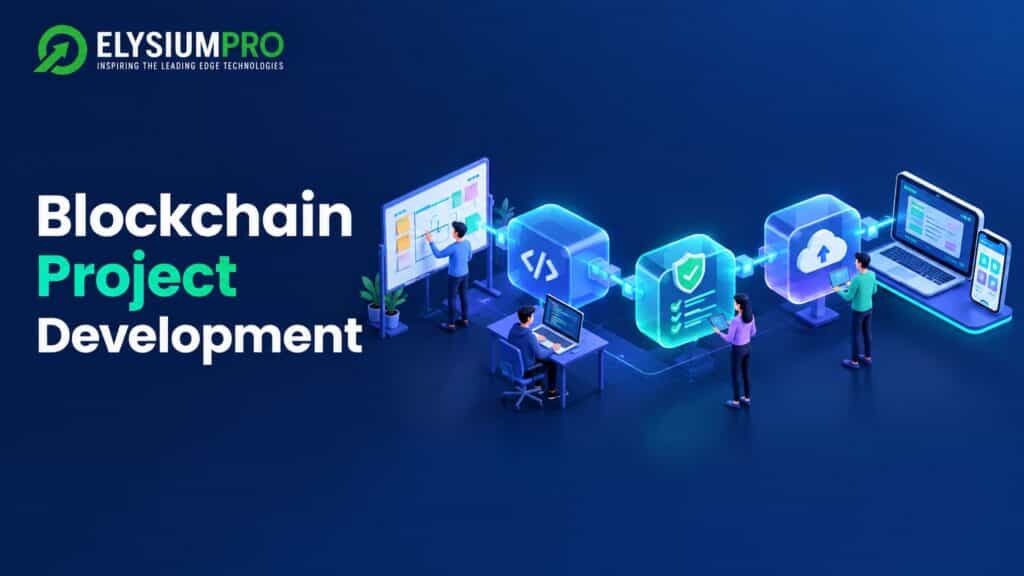
Introduction
Blockchain can make shared records tamper-evident, automate agreements, and let partners trust data without a central gatekeeper. Yet many blockchain initiatives stall after a flashy demo because the use case was weak, the platform was wrong, or security was an afterthought. Successful blockchain project development avoids these traps with a clear, step-by-step process.
In this guide, we start with an honest question: does your project need a blockchain at all? Then we compare platforms, walk through the eight development phases, outline the team you need, and share typical costs in India. We also include a worked example of a supply chain traceability MVP and a security checklist.
At Elysiumpro, we guide students, startups, and businesses through blockchain builds, from first prototype to tested application. This guide reflects the questions we hear most often from both groups.
What Is Blockchain Project Development?
Blockchain project development is the end-to-end process of turning an idea into a working application that uses a blockchain for shared, tamper-evident records or automated rules. It covers use-case validation, platform choice, smart contract and application development, testing, security audits, deployment, and ongoing maintenance.
- At a Glance: Blockchain Project Development
- Core components: Smart contracts, off-chain backend, web or mobile front end, wallet or identity layer
- Common platforms: Ethereum and its Layer 2 networks, Polygon, Solana, Hyperledger Fabric
- Typical timeline: 4–8 weeks for a proof of concept; 3–9 months for an MVP or production app
- Must-have step: Independent smart contract security review before mainnet launch
- Best fit: Multi-party processes that need shared, verifiable records
In practice, most blockchain application development is regular software engineering with one extra layer: code that runs on a shared ledger and is hard to change once deployed.
Does Your Project Really Need a Blockchain?
Many projects do not need a blockchain, and honest blockchain project development starts by checking. Answer these five questions before you commit budget.
| Question | If yes | If no |
|---|---|---|
| Do several independent parties need to share and update the same records? | Blockchain may help | A central database is simpler |
| Is there no single intermediary that all parties trust? | Blockchain may help | Use the trusted party's system |
| Must records be tamper-evident and auditable over time? | Blockchain may help | Standard logging may be enough |
| Do you need automated rules that no single party controls? | Smart contracts fit | Normal backend logic works |
| Can sensitive data stay off-chain? | You can proceed safely | Rethink the design first |
As a rule of thumb, if you answer "yes" to at least three of the first four questions and "yes" to the last one, blockchain is worth exploring further.
What Are the Best Blockchain Project Ideas for Businesses?
The best blockchain project ideas involve several parties who need a shared, trusted record. These use cases have the strongest track record.
| Use case | What blockchain adds | Example industries |
|---|---|---|
| Supply chain traceability | Shared product history from source to shelf | Food, pharma, textiles |
| Credential and certificate verification | Instant, tamper-evident verification | Education, HR, licensing |
| Tokenized loyalty programmes | Points shared across partner brands | Retail, travel, hospitality |
| Trade finance documents | One shared version of bills and invoices | Banking, logistics |
| Asset and land registries | Transparent ownership history | Real estate, government |
| Healthcare consent management | Auditable patient consent records | Hospitals, insurers |
| Carbon credit tracking | Transparent issuance and retirement | Energy, manufacturing |
If you are a student, our guide to blockchain projects for students lists smaller, semester-sized ideas.
Who Do You Need on a Blockchain Development Team?
A blockchain development team combines standard software roles with a few specialists. A proof of concept can run with three or four people, while a production application usually needs six to eight.
| Role | Main responsibility |
|---|---|
| Product owner or business analyst | Defines the use case, users, and success metrics |
| Blockchain architect | Chooses the platform and designs on-chain and off-chain parts |
| Smart contract developer | Writes, tests, and optimizes contracts |
| Backend developer | Builds APIs, off-chain databases, and integrations |
| Front-end or mobile developer | Builds the interface and wallet or login experience |
| QA and security engineer | Tests functionality and prepares for the audit |
| DevOps engineer | Manages nodes, deployments, and monitoring |
If you lack these skills in-house, experienced blockchain development services can fill the gaps while your team learns.
How Much Does Blockchain Project Development Cost?
Blockchain project development in India typically costs from ₹3 lakh for a proof of concept to more than ₹1 crore for an enterprise network. Scope, platform, integrations, and audit requirements drive most of the difference.
| Project type | Typical cost (INR) | Typical timeline |
|---|---|---|
| Proof of concept (PoC) | ₹3–8 lakh | 4–8 weeks |
| MVP dApp with web app | ₹8–25 lakh | 3–5 months |
| Production dApp with audit | ₹25–75 lakh | 5–9 months |
| Enterprise permissioned network | ₹40 lakh–₹1.5 crore+ | 6–12 months |
| Independent smart contract audit | ₹2–15 lakh | 2–6 weeks |
In addition, plan for ongoing costs: node or infrastructure hosting, transaction fees on public chains, monitoring, and annual maintenance of roughly 15–20% of the build cost.
What Are the 8 Phases of Blockchain Project Development?
Blockchain project development moves through eight phases. Each one ends with a clear deliverable, so problems surface before they become expensive.
Phases 1–4: Validate and Design
- Discovery and blockchain-fit assessment: Map stakeholders, pain points, and the five fit questions above.
- Platform selection: Choose a public, Layer 2, or permissioned network based on access, cost, and scale.
- Architecture and data design: Decide what goes on-chain, what stays off-chain, and how users sign in.
- UX and UI design: Design simple flows that hide wallet complexity from non-technical users.
Phases 5–8: Build, Secure, and Launch
- Smart contract and application development: Build contracts, backend services, and front ends in short sprints.
- Testing and security audit: Run unit, integration, and security tests, then commission an independent audit.
- Deployment: Launch on a testnet with pilot users, fix issues, then deploy to mainnet or the production network.
- Monitoring and upgrades: Track transactions and errors, and plan safe upgrade paths for contracts.
What Does a Real Blockchain Application Development Project Look Like?
Here is an illustrative example of blockchain project development for an organic food cooperative. The cooperative wanted buyers to scan a QR code and see each product's journey from farm to store. The team built an MVP on a low-fee public network in 20 weeks.
| Work stream | Cost (₹ lakh) |
|---|---|
| Discovery and blockchain-fit assessment | 1.5 |
| UX and UI design | 2.0 |
| Smart contract development | 4.0 |
| Testing and external audit | 3.5 |
| Web and mobile apps with QR scanning | 4.5 |
| Integrations (ERP export, IoT temperature sensors) | 1.5 |
| Deployment, pilot, and training | 1.0 |
| Total | 18.0 |
Only batch IDs, data hashes, and timestamps went on-chain, while farmer details stayed in an off-chain database. Buyers could view a product's origin in under three seconds, and the cooperative could trace a batch for a recall in about 15 minutes instead of two days. Notably, testing and the audit took about a fifth of the budget, which is typical for responsible builds.
How Do You Keep Blockchain Applications Secure?
Security is critical because deployed smart contracts are hard to change and may control valuable assets. Build these practices into every project:
• Reuse audited libraries: Use well-tested components such as OpenZeppelin Contracts instead of writing everything from scratch.
• Check common risks: Review your code against the OWASP Smart Contract Top 10.
• Commission an independent audit: Have external experts review contracts before mainnet launch.
• Protect admin keys: Use multi-signature wallets and secure key storage for privileged actions.
• Plan upgrades carefully: Decide early whether contracts are upgradeable and how changes are approved.
• Monitor continuously: Track unusual transactions and set alerts for failures.
What Mistakes Should You Avoid in Blockchain Project Development?
Most failed blockchain projects share a few avoidable mistakes. Watch for these six.
- Using blockchain without a clear fit: If one party controls the data, a database is usually better.
- Putting personal data on-chain: Public ledgers are permanent and visible; store hashes instead.
- Skipping the audit: One contract bug can cause losses that far exceed audit costs.
- Ignoring user experience: Complex wallet steps drive non-technical users away.
- Underestimating integrations: Connecting ERPs, IoT devices, and payment systems takes real effort.
- Launching too big: A focused MVP proves value faster than a feature-heavy first release.
Final Thoughts on Blockchain Project Development
Successful blockchain project development starts with an honest fit assessment, then moves through careful platform choice, clear on-chain and off-chain design, thorough testing, and an independent audit. Begin with a proof of concept or MVP, involve real users early, and keep security at the centre of every decision.
If you are planning a blockchain solution, Elysiumpro offers consultation, custom blockchain development, and mentoring for students and startups. Explore our blockchain development services or talk to an Elysiumpro expert to discuss your idea.